

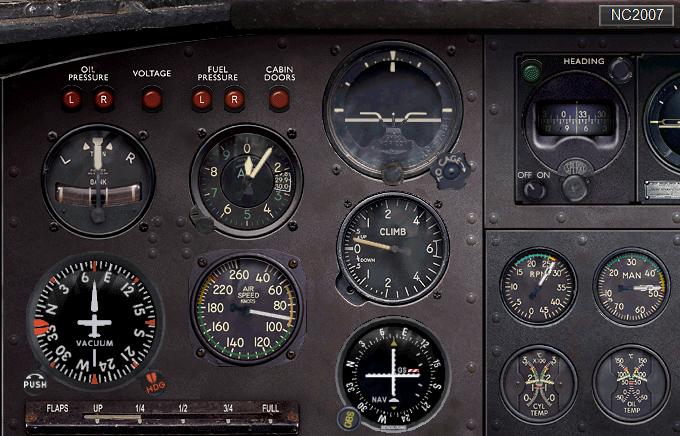
There's very little reconfiguring of the aircraft needed on a Go Around,
which is as it should be. The pilot's total focus should be on flying the
aircraft and safely gaining some altitude.
On a go around responsively, but smoothly, shove the throttles forward to
full power—48 in. MP. (Pressing the F-4 Key will do that). The props were
already moved into the high RPM position during approach in preparation of a
go-around, if necessary. Stop the descent; raise the flaps up to the first
notch, one-quarter, but leave the gear down for the moment. Don't let the
aircraft sink as the flaps bleed off.
You might wonder, as I did, why raise the flaps before the gear on a
go-around? Here's the wonderfully succinct answer I got from one DC-3
captain when I raised this question on a forum. I thought a pilot would want
to "first eliminate the horrible drag of the landing gear."
"If you were to sink towards the runway on a go-around, would you rather
have flaps or gear? The split flaps on the DC-3 create more drag than lift,
and the drag from the gear is not horrible.
In a single or twin, it's never gear up until a positive rate of climb is
established, and that is difficult if not impossible with full flaps."
Another DC-3 Captain justified raising flaps first this way:
"It´s pretty simple, DC-3 has split flaps. At full flaps it generates
approximately 200% drag and 35% lift."
Don't be in a hurry to gain too much altitude. Continue to bleed off the
flaps, climb out at 90 kts and 300 fpm. Once a positive rate of climb has
been established, reduce the power to climb, 36" MP, 2350 RPM, and raise the
gear. At 1000 ft. AGL reduce the throttles and props to the slow-flight
configuration for another try or to enter the holding pattern.
If circumstances force you to another destination, then stay in the climb
configuration and go to the assigned altitude and be on your way.
Here is a fun-flight to practice your go-around skills. It takes only 15
to 20 minutes and starts on Runway 23 of Quonset State Airport, KOQU, in
North Kingstown, Rhode Island. The destination airport is Elizabeth Field on
Fishers Island, NY, 35 NM to the southwest. Its airport ID is 0B8.
Again, click here to download 1200.zip for the
FSNavigator flight plan if necessary. You will use 1200-0b8.fsn for this
flight.
Elizabeth Field has two runways ... you will be landing straight in on Rwy
25, 1790 ft in length and 75 ft. wide.
NOTE: Be forewarned, Elizabeth Field’s Runway 25 is too
short for a DC-3 to take-off from. Use Rwy 12/30 for take-offs. It is 2324
ft in length.
This is a favorite "take-a-break" flight for me. Short, easy, but
challenging on the approach and landing. Plus you get to exercise all nine
segments of a flight. You're likely to put it in the same "favorite"
category.