

Before moving on, there is one more flight routine that will really sharpen your flying skills. Appropriately enough, it's called:
Practice, Practice, Practice
This practice session is fairly simple, incorporating airspeed control, level turns, descents and climbs. Fly the practice pattern with the visibility and ceiling set to minimums so that you have only the instruments for reference. All later flight manoeuvres will be simple once you have mastered this pattern.
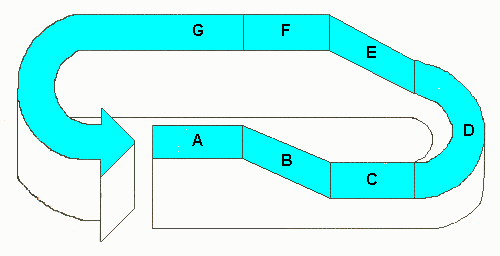
It's easiest to fly this practice pattern if you first
click here to
download the picture and flight instructions.
Begin the flight at 1000 ft AGL, then:
When you fly this pattern the second time, make the turns in the opposite
direction, and alternate the directions of the turns from then on.
During the descent segment—B—you should use as many different aircraft
configurations as you can. In other words, make one simulated approach in
the clean configuration, using only power to adjust the rate of descent.
Then, make a descent by lowering the gear, adjusting power as necessary to
maintain a 500-fpm descent. Finally, use various flap settings, with and
without the gear, paying attention to the specific pitch attitude and the
approximate power setting needed for each type of descent. This sounds
complicated, but the variations are only for one segment, B.
Next, fly the level turn segment—D—with the gear down and the flaps in the
clean and the proper manoeuvring position. No matter what configuration you
are using in segment D, you have to remember to clean up the aircraft—raise
the flaps and gear—when you begin the climb in segment E.
Learn the DC-3 thoroughly. Practice this pattern once a day until
controlling the aircraft becomes second nature, which will happen sooner
than you think.
Practice until:
Once you have mastered this basic pattern, you can make one change in it
that will turn it into a procedure that at one time was part of all ATP
flight tests: the Canyon Approach was, and is, an excellent test of
aircraft control.
As the captain of an aircraft, you have been cleared for an approach to an
airport located in a canyon. You reduce power to approach airspeed in
segment A. At the beginning of segment B you cross the initial approach
fix—a radio beacon theoretically located on the rim of the canyon—at 1000
ft, lower gear and flaps, and descend to a minimum descent altitude of 500
ft.
Once down to the 500 ft minimum descent altitude, you fly out the allotted
time, which in this pattern is depicted as segment C—one minute at approach
speed—and when you don't see the airport, you initiate the missed approach
procedure. In this case; the missed approach procedure calls for an
immediate 180-degree climbing turn as depicted in segment D, which will take
you back to the 1000 ft initial altitude. Naturally, the gear and flaps must
be retracted during the wave-off.
The one change you have made to the original practice pattern is that you no
longer make that nice level turn at D. Instead, you have combined segments D
and E into a climbing turn. Still, it's necessary to be at the initial
altitude and the reciprocal heading as you complete the one-minute climbing
turn.
Courtesy, J. R. Williams, The Art of Instrument Flying